Explore Math Concepts Through Rubik's Cube Challenges
The Rubik's Cube is more than just a colorful puzzle; it is a gateway to understanding complex mathematical concepts. Whether you're a teacher looking for innovative ways to engage students or a math enthusiast eager to explore new dimensions of problem-solving, the Rubik's Cube offers a unique blend of fun and education. In this blog post, we will delve into how you can explore various math concepts through Rubik's Cube challenges, making learning both enjoyable and effective.
Understanding the Basics of the Rubik's Cube
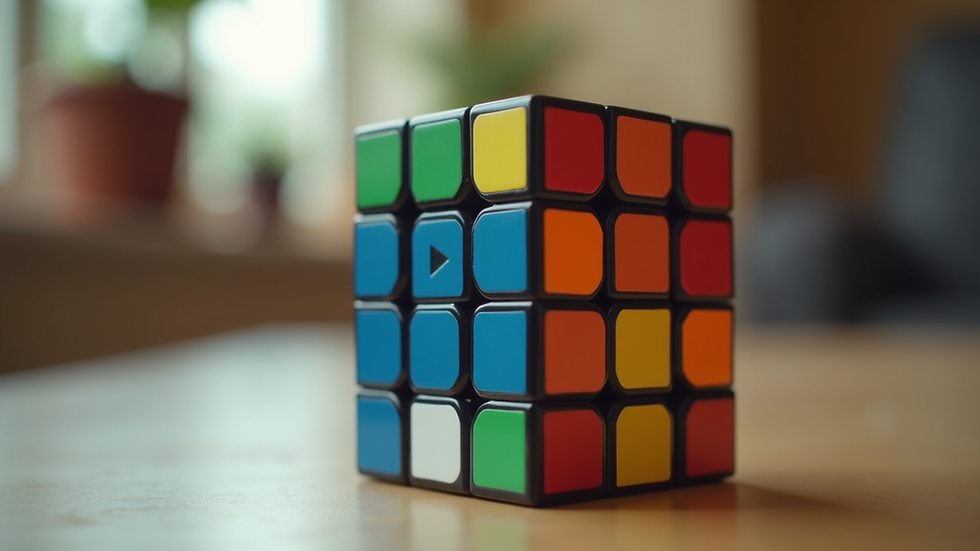
Before diving into the mathematical concepts, it's essential to understand the structure of the Rubik's Cube. The standard cube consists of:
6 faces: Each face is a different color.
54 stickers: Each sticker represents a small square on the face.
26 smaller cubes: These are the building blocks of the cube, known as cubies.
The goal is to twist and turn the cube until each face is a solid color. This seemingly simple task involves a surprising amount of mathematical reasoning.
Group Theory and the Rubik's Cube
One of the most fascinating areas of mathematics that the Rubik's Cube touches upon is group theory. Group theory studies algebraic structures known as groups, which consist of a set of elements and an operation that combines them.
The Cube as a Group
In the context of the Rubik's Cube, each twist or turn can be seen as an operation within a group. The set of all possible configurations of the cube forms a group, where:
Elements: Each configuration of the cube.
Operation: The action of twisting a face.
The Rubik's Cube has over 43 quintillion possible configurations, but only a finite number of moves can lead to a solution. This is a perfect example of how group theory can help us understand complex systems.
Practical Challenge: Group Theory Exploration
To explore group theory using the Rubik's Cube, try the following challenge:
Choose a Starting Configuration: Scramble the cube.
Record Your Moves: Write down each move you make.
Analyze the Group: Determine how many unique configurations you can create with a specific set of moves.
This exercise not only enhances your understanding of group theory but also improves your problem-solving skills.
Combinatorics and Permutations
Another mathematical concept that the Rubik's Cube illustrates is combinatorics, particularly permutations. A permutation is an arrangement of objects in a specific order, and the Rubik's Cube is a perfect example of this.
Counting Permutations
The number of ways to arrange the stickers on a Rubik's Cube can be calculated using permutations. For example, if you consider just one face of the cube, the number of ways to arrange the 9 stickers is:
\[
9! = 362,880
\]
However, since the cube has constraints (like the fixed center pieces), the actual number of permutations is much lower. Understanding these constraints can lead to deeper insights into combinatorial mathematics.
Practical Challenge: Permutation Exploration
To explore permutations with the Rubik's Cube, try this challenge:
Select a Face: Choose one face of the cube.
Scramble the Stickers: Randomly rearrange the stickers on that face.
Count the Arrangements: Calculate how many unique arrangements are possible given the constraints of the cube.
This exercise will help you grasp the concept of permutations in a tangible way.
Geometry and Spatial Reasoning
The Rubik's Cube also serves as an excellent tool for exploring geometry and enhancing spatial reasoning skills. Understanding the cube's three-dimensional structure can help develop critical thinking and visualization abilities.
Geometric Shapes and Properties
The Rubik's Cube consists of various geometric shapes, including:
Cubes: The basic unit of the puzzle.
Planes: Each face of the cube represents a plane in three-dimensional space.
Understanding these shapes can lead to discussions about volume, surface area, and symmetry.
Practical Challenge: Geometric Exploration
To explore geometry using the Rubik's Cube, consider the following challenge:
Measure the Cube: Use a ruler to measure the dimensions of the cube.
Calculate Volume and Surface Area: Use the measurements to calculate the volume and surface area of the cube.
Discuss Symmetry: Explore the symmetrical properties of the cube and how they relate to geometric concepts.
This hands-on activity will deepen your understanding of geometry while making learning interactive.
Algebra and Algorithms
Algebra plays a significant role in solving the Rubik's Cube. The algorithms used to solve the cube can be expressed in algebraic terms, making it an excellent tool for teaching algebraic concepts.
Understanding Algorithms
An algorithm is a step-by-step procedure for solving a problem. In the case of the Rubik's Cube, algorithms are sequences of moves that lead to a solution. For example, one common algorithm is the Fridrich Method, which involves a series of specific moves to solve the cube efficiently.
Practical Challenge: Algorithm Exploration
To explore algebra through the Rubik's Cube, try this challenge:
Learn an Algorithm: Choose a popular algorithm for solving the cube.
Practice the Moves: Execute the algorithm multiple times to become familiar with it.
Create Your Own Algorithm: Experiment with different sequences of moves to create your own algorithm for solving a specific configuration.
This exercise will help you understand the importance of algorithms in mathematics and problem-solving.
Engaging Students with Rubik's Cube Challenges
For educators, incorporating the Rubik's Cube into the classroom can be a game-changer. Here are some strategies to engage students with Rubik's Cube challenges:
Group Activities
Organize group activities where students work together to solve the cube. This fosters teamwork and collaboration while allowing students to share different strategies and approaches.
Math Competitions
Host math competitions that involve solving the Rubik's Cube. This can motivate students to improve their skills and learn new techniques.
Integration with Curriculum
Integrate Rubik's Cube challenges into the math curriculum. Use it as a tool to teach concepts like group theory, permutations, geometry, and algebra.
Conclusion
The Rubik's Cube is a powerful educational tool that can help students and math enthusiasts explore various mathematical concepts in an engaging way. By incorporating challenges related to group theory, combinatorics, geometry, and algebra, you can make learning math enjoyable and interactive.
So, grab a Rubik's Cube and start exploring the fascinating world of mathematics through its colorful twists and turns. Whether you're teaching in a classroom or learning on your own, the cube offers endless opportunities for discovery and growth.

Comments